
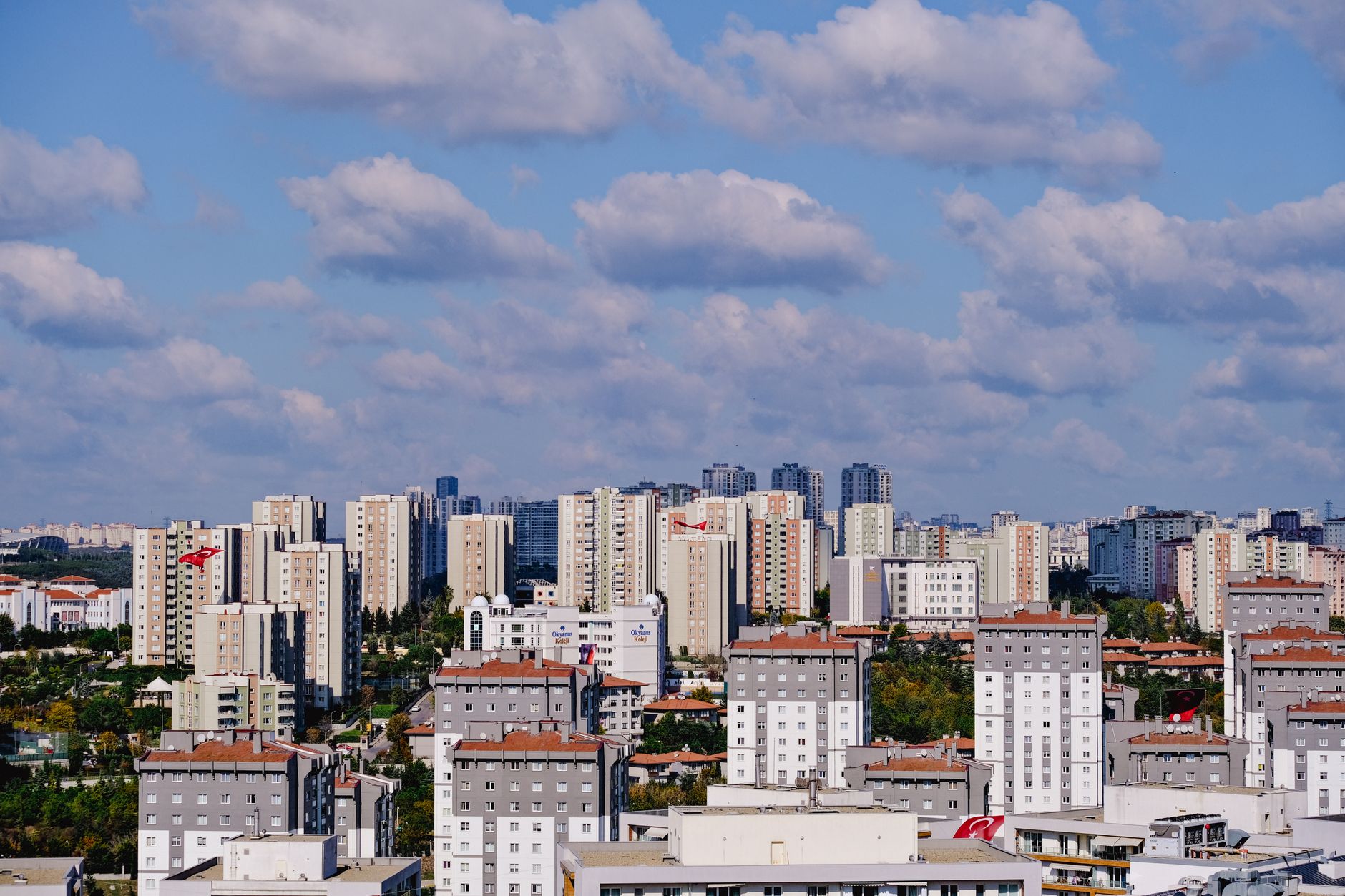
Property insurance in Turkey in 2026 consists of a mandatory DASK earthquake policy and optional residential property insurance (konut sigortası) if desired by the owner. DASK is mandatory for any property owner, including foreign nationals. Without an active policy, you cannot complete a transaction at Tapu or open water and electricity contracts. A policy for a 100 m² apartment in 2026 costs approximately 900 to 3,500 TL per year, depending on the seismic risk group of the address.
DASK: Who Must Have It and What It Covers
DASK (Zorunlu Deprem Sigortası, mandatory earthquake insurance) was established under Law No. 6305 on Disaster Insurance. Policies are issued exclusively by the state institution — Doğal Afet Sigortaları Kurumu — though insurance companies and agents sell them on DASK's behalf. Premiums are identical across all providers because tariffs are set by the government.
The following must be insured (Article 10 of the law):
- apartments and other independent building units under Condominium Law No. 634;
- residential houses built on private land registered with Tapu;
- offices and shops located within residential buildings.
Responsibility rests with the property owner or the holder of usufruct rights (intifa), and the policy must be renewed annually. The law makes no distinction between Turkish citizens and foreign nationals. Official housing, government buildings, rural houses within village boundaries, and entirely non-residential structures are exempt from mandatory coverage. DASK may refuse to insure buildings constructed in violation of design specifications and does not cover structures with compromised load-bearing frames.
The policy covers damage to the building itself from earthquakes, as well as from fires, explosions, tsunamis, and landslides triggered by earthquakes. Payments are made in cash up to the policy limit. According to DASK's official list, the policy does not cover:
- furniture, appliances, and other personal property;
- loss of rental income and temporary housing expenses;
- debris removal;
- bodily injury or death.
The deductible is 2% of the policy limit per claim (a series of tremors within 72 hours is considered a single claim). If an owner has renovated the apartment in a way that damages load-bearing structures and damage results from this, they forfeit their right to compensation (Article 12 of the law).
DASK Costs in 2026
The policy limit is calculated by multiplying the gross floor area by the standard per-square-meter cost for the building type. Building types are classified as "betonarme" (reinforced concrete or steel frame structures) or "diğer" (all others). Standards and maximum limits are adjusted monthly based on the TÜİK Producer Price Index. If prices increase during the policy period, the policy limit rises with no additional premium required.
- From October 1, 2026: 12,039 TL per m² for betonarme and 8,026 TL per m² for diğer. Maximum policy limit — 2,552,268 TL.
- From November 1, 2026: 12,288 TL and 8,192 TL. Maximum limit — 2,605,100 TL.
This leads to a practical observation: for a reinforced concrete apartment with a gross area exceeding approximately 212 m², the policy limit reaches its maximum. DASK will not cover reconstruction costs beyond this cap.
The premium is the policy limit multiplied by the rate. The rate depends on the risk group (I — highest, VII — lowest) and building type. The risk group is determined by Turkey's seismic hazard map, soil conditions, and building characteristics. It is assigned to a specific address rather than uniformly across a province. To find your property's risk group in Alanya or Antalya, check the premium calculation or visit DASK's interactive map on their website.
| Risk Group | Betonarme Rate, ‰ | Diğer Rate, ‰ | Premium for 100 m² betonarme (policy from Oct 1, 2026), TL |
|---|---|---|---|
| I | 2.82 | 4.96 | 3,395 |
| II | 2.51 | 4.25 | 3,022 |
| III | 2.13 | 3.73 | 2,564 |
| IV | 2.00 | 3.49 | 2,408 |
| V | 1.50 | 2.79 | 1,806 |
| VI | 1.07 | 1.86 | 1,288 |
| VII | 0.73 | 1.09 | 879 |
For reinforced concrete buildings, adjustments to the rate are applied and combined:
- +10% if the construction permit was issued before 2000;
- +10% for buildings with 8 or more above-ground floors;
- −10% for buildings with 3 or fewer above-ground floors.
If renewed within 30 days of expiration, a 20% discount applies to both building types. Each risk group has a minimum premium. At the start of 2026, this ranged from 1,951 TL (Group I) to 505 TL (Group VII), with these amounts indexed monthly thereafter.
Example: a 100 m² apartment in a new 10-story complex, Risk Group III, policy effective October 1, 2026. Policy limit — 1,203,900 TL, premium — 2,564 TL plus 10% for building height, approximately 2,820 TL. Deductible in case of loss — 24,078 TL.
Where to Obtain DASK and When It Is Required
Policies are obtained through any authorized insurance company, its agent, or a bank branch offering insurance services. You will need:
- address code (UAVT);
- Tapu details;
- year of construction, building type, and number of floors;
- gross floor area;
- tax identification number or ikamet number of the owner and phone number.
The policyholder is responsible for data accuracy. Understating the area will reduce the policy limit and any potential payout. Policy term is one year. Active policies can be verified on the DASK website under "Poliçe Sorgulama."
The law ties DASK to three operations (Article 11):
- Tapu. The land registry does not register property transactions until an active policy dated on the transaction date is confirmed.
- Water and electricity. When opening a utility account, the provider verifies DASK coverage. This applies to tenants as well: without the owner's policy, utilities cannot be transferred to the tenant's name.
- Mortgage. If a borrower fails to obtain DASK, the bank arranges and renews the policy independently, notifying the borrower.
An important 2026 change affects buyers. According to DASK guidance, for sales registered from September 5, 2026 onward, the seller's policy terminates on the transaction date at Tapu and does not transfer to the buyer. The buyer must obtain their own policy in their name beforehand, and Tapu verifies it during the transaction. This rule applies equally to Tapu transactions and notarized sales. The seller may recover the premium for unused days by submitting a request to their agent or insurer. For details on how the transaction itself proceeds, see our article on buying property in Turkey, and for information on the ownership document, see our article on Tapu.
A tenant cannot obtain DASK in their own name. They may pay the premium as the policyholder, but the property owner registered with Tapu remains the beneficiary.
Konut Sigortası: Voluntary Residential Property Insurance
Konut sigortası is voluntary insurance offered by private insurers and is not required by law. It is based on standard fire insurance terms (Yangın Sigortası Genel Şartları). Basic coverage includes fire, lightning, explosions, and damage from related smoke, steam, and heat. Additional riders can be added for:
- internal water damage (dahili su) — pipe leaks and water from neighboring units;
- flooding, storms, landslides, and snow load;
- vehicle impact and malicious acts;
- loss of rental income and debris removal;
- earthquake coverage exceeding the DASK limit.
Theft is not covered under standard fire insurance terms. Packaged policies include it as separate coverage, along with broken glass, personal property inside the apartment, and emergency repair services. Coverage options and limits vary by insurer, so review the policy's special conditions before purchase.
Voluntary earthquake insurance is permitted only when an active DASK policy is in place, and only for coverage amounts exceeding the DASK sum insured. If a property lacks DASK, the insurer will arrange it first when issuing any policy that includes earthquake risk.
For property owners who rent out their homes, konut sigortası is especially valuable. Coverage for water damage to neighbouring properties and loss of rental income resolves the most common disputes with tenants. It's worth arranging this in advance if you plan to rent out an apartment in Alanya.
| Parameter | DASK | Konut sigortası |
|---|---|---|
| Mandatory or voluntary | Mandatory by Law No. 6305 | Voluntary |
| Issued by | State-backed DASK through insurance companies and agents | Private insurance company |
| Covered risks | Earthquake and resulting fire, explosion, tsunami, landslide | Fire, lightning, explosion; optionally water damage, flooding, storm, theft, glass and others |
| Contents inside the property | Not covered | Can be insured |
| Coverage limit | Property area × per-m² standard, max 2,605,100 TL (from 01.11.2026) | By contract, typically reconstruction cost and contents value |
| Premium | Unified state tariff | Set by the insurer |
| Required for | Tapu, water, electricity, mortgage | Not required anywhere; bank may offer it with a loan |
Insurance and mortgage requirements
Under the Housing Finance Contracts Regulation (Konut Finansmanı Sözleşmeleri Yönetmeliği, Article 10), a bank cannot arrange insurance linked to a credit facility without explicit written or electronic consent from the borrower. When offering a loan with insurance, the bank must also offer a loan-only option. A borrower may provide a policy from any insurance company if the coverage amount and term match the loan and the bank is named as the mortgagee (dain-i mürtehin). The bank must accept such a policy without worsening the loan terms.
These rules do not apply to DASK: it is mandatory regardless, and the bank will renew it if the borrower fails to do so. For this reason, it makes sense to compare the bank's insurance package with policies from other insurers before signing the credit agreement.
What to do in case of an insured event
- After an earthquake, report the damage by calling ALO DASK 125. Provide your policy number and address.
- Take photos of the damage before any repairs and do not start work on structural elements until an expert has inspected the property.
- Prepare a copy of your ID (for a foreign national, passport or ikamet) and a current Tapu extract.
- By law, DASK settles claims within 30 days of damage assessment completion and document submission. A 2% deductible is applied to the payout.
- For konut sigortası claims (water damage, fire, theft), contact your insurance company using the number on your policy. For theft, insurers typically request a police or gendarmerie report; for water damage, proof of the cause. Notification deadlines are specified in your policy terms.
If you do not live in Turkey, arrange a power of attorney in advance for a representative who can meet the inspector and submit documents.
Frequently asked questions
Is a foreign national required to obtain DASK?
Yes. The obligation rests on the property owner regardless of citizenship. Without a policy, you cannot complete a Tapu transaction or open water and electricity contracts.
Does DASK transfer to the buyer when purchasing a property?
No. For sales from 5 September 2026, the seller's policy terminates on the transaction date, and the buyer must arrange a policy in their own name in advance.
Can an apartment in a building under construction be insured?
Incomplete buildings do not fall under DASK. A policy is arranged once the apartment has a cadastral record as a residential property, including under kat irtifakı.
Does DASK cover furniture and appliances?
No, only the building structure. Contents are insured separately through voluntary konut sigortası.
What happens if DASK is not renewed?
There is no penalty in the law, but without an active policy you cannot complete a Tapu transaction or renew utility contracts. Most importantly, any earthquake damage will not be covered. Renewal within 30 days after expiry qualifies for a 20% discount.
Who pays DASK for a rental property?
By law, the property owner. A tenant may pay the premium on the owner's behalf, but cannot arrange DASK in their own name.
Sources
- Law No. 6305 "Afet Sigortaları Kanunu" — mevzuat.gov.tr
- Zorunlu Deprem Sigortası Tarife ve Talimat Tebliği (as of 31.12.2025) — mevzuat.gov.tr
- DASK: tariffs, per-m² standards and maximum coverage 2025–2026
- DASK: coverage and exclusions
- DASK: frequently asked questions (sale, Tapu, water and electricity, deductible, 125)
- Konut Finansmanı Sözleşmeleri Yönetmeliği — mevzuat.gov.tr
- Yangın Sigortası Genel Şartları — Türkiye Sigorta Birliği